You lift the cover after a long day and the water is lukewarm. The topside panel is blinking two letters you’ve never seen before, and the jets sound weaker than they did last week. If you own a spa anywhere in Los Angeles, from the Valley to the Westside, that moment is familiar. This guide covers Jacuzzi troubleshooting for Los Angeles owners: what the common codes usually mean, what you can safely check yourself, and when it’s time to call us.
First, what an error code is really telling you
A hot tub control system is a watchdog. It reads water temperature, flow, and sometimes pressure dozens of times a minute. When a reading falls outside the range it expects, the controller does two things. It shuts down the part at risk, usually the heater. Then it posts a code so you know why.
That second part matters. A code is not always a broken part. Often it’s a symptom of something simple upstream, like a clogged filter starving the heater of water. Sometimes it really is a failed sensor or pump. The code points you to the neighborhood of the problem, not the exact house.
One more thing before the codes themselves. Jacuzzi error codes differ by model year and control system, and other spa brands use their own wording. Always check your owner’s manual for the exact meaning on your panel. What follows are the patterns we see most often on spas around Los Angeles.
Common Jacuzzi error codes and what they usually mean
The table below groups the messages we’re called about most. For each one, it lists the usual cause, a safe homeowner check, and the point where a technician should take over.
| Code (typical) | What it usually means | Safe check you can do | Call a pro when |
|---|---|---|---|
| FL / FLO / HFL | The controller isn’t seeing enough water flow through the heater | Clean or remove the filter, confirm the water level is above the skimmer, make sure valves are open | The code returns with a clean filter and full water |
| LF / Low Flow | Flow is reduced but not stopped, often a partial blockage | Rinse filters, clear debris from the skimmer basket | Jets feel weak across the whole tub or the pump sounds strained |
| dr / dry | Possible dry heater, sometimes from an air lock after a refill | Top off water, power down and let it sit before restarting | It reappears after a refill or the heater never warms |
| OH / OHH / HH | Water or heater temperature is too high | Leave the cover off, check that the set temperature is reasonable, clean the filter | Temperature keeps climbing or the code repeats |
| SnS / SN / Sensor | A temperature sensor is reading out of range or disagreeing with its partner | Note when it appears and whether a power cycle clears it | Almost always: sensors and wiring are pro work |
| ICE / Freeze | The spa sensed cold water and is running pumps to protect plumbing | Usually nothing; it’s protective. Keep the cover on | It runs constantly on mild nights, which can signal a sensor issue |
| Blank panel / no power | Tripped breaker, GFCI trip, or a failed board or component | Note whether the GFCI tripped and how fast it trips again | Any repeat trip. Don’t keep resetting it |
Flow codes are the big one. On the tubs we service, they account for a large share of call-outs, and a lot of them clear up with a filter clean. When they don’t, we’ve written a deeper look at why the FL code keeps coming back, covering everything from closed slice valves to a failing circulation pump.
Hot tub troubleshooting you can safely do at home
Plenty of codes clear up with basic care. Here’s what’s safe for any owner to try. Anything beyond this list involves electrical, gas, or pressurized components, and that’s licensed professional territory.
Start with the filter
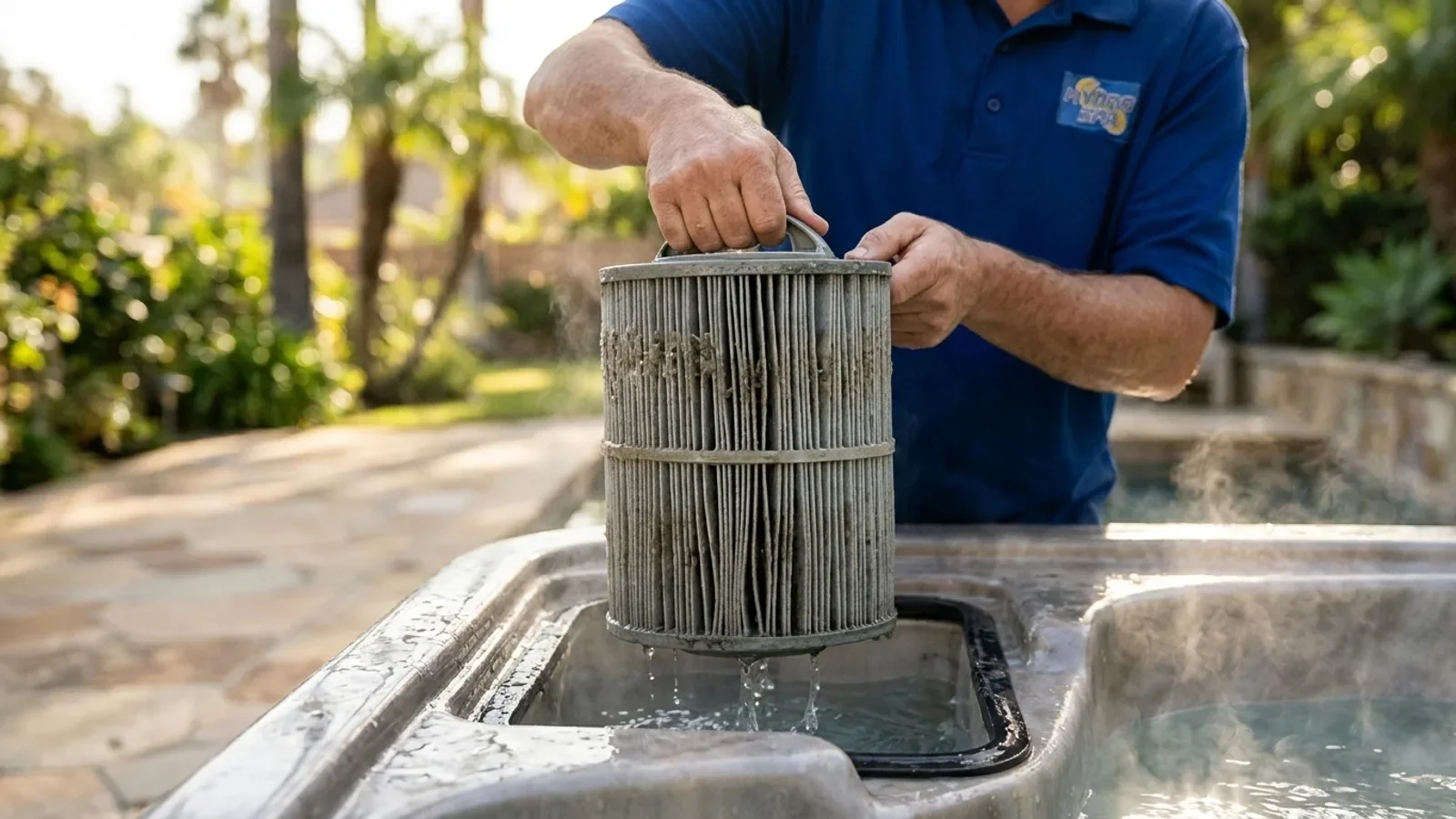
Pull the filter cartridge and look at it. If the pleats are gray, matted, or crusty, rinse it thoroughly with a garden hose. Many owners keep a spare so one can dry while the other works. If a flow code clears with the filter removed, you’ve found your culprit. Don’t run the tub long-term without a filter, though. Debris will reach the pump and heater.
Check water level and valves
Low water lets the skimmer suck air, and air confuses flow sensors. Top it off so the water sits comfortably above the skimmer opening. Then look for any shutoff or slice valves near the equipment and make sure none were bumped closed during cleaning.
Power cycle once, and only once
Switching the spa off at the panel’s disconnect, waiting a minute, and restarting can clear a one-time glitch. If the code returns, stop there. Resetting over and over hides a real fault and can stress components that are already struggling.
Here’s the line we hold firmly. Don’t open the equipment bay to test wiring, bypass sensors, or swap heater elements. Spa equipment combines water and high-voltage power. That combination needs a licensed technician.
The Los Angeles factors behind your spa’s codes
We’ve worked on hot tubs all over the LA basin. A few local conditions show up in our repair logs again and again, and they explain why some codes are more common here than in a manual’s generic troubleshooting chart.

Hard water and scale
Much of Los Angeles is supplied by water that’s on the hard side, rich in calcium and other minerals. When that water is heated day after day, minerals drop out and coat heater elements, sensors, and the inside of plumbing. Scale insulates the heater, so it runs hotter to do the same job. That can trigger overheat codes and shorten element life. Scale on a sensor can also skew its reading. Our guide to how mineral scale builds up on spa heaters explains the signs and what helps slow it down.
Sun, heat, and Santa Ana winds
A spa sitting in full afternoon sun in the Valley or Inland neighborhoods can climb in temperature on its own during a heat wave. Add circulation running in the heat of the day and you may see overheat messages in late summer. In fall and winter, dry Santa Ana winds push leaves, ash, and grit under covers and into skimmers. That debris clogs filters fast, which is a direct path to flow errors.
Cool nights and older electrical panels
Southern California winters are mild, but nights do get chilly, and spas heat harder this time of year. More heater run time puts more load on the electrical circuit. Many LA homes, especially older bungalows and mid-century houses, have panels that were updated piecemeal over the decades. A tired breaker or a marginal GFCI can trip under that load. If yours is cutting out, read about what a tripping breaker usually means for a hot tub before anyone touches the panel. Electrical requirements vary by city and installation, so a licensed professional should evaluate it.
Tight yards and hillside lots
From Silver Lake hillsides to compact Westside lots, a lot of LA spas are tucked against walls or fences. Poor airflow around the equipment bay can let components run warm. Limited access also makes it easy to skip routine checks, so small problems become codes.
When a code means it’s time for a Jacuzzi repair service in Los Angeles
Some codes are a nudge. Others are the spa telling you a part is failing. These are the signs we’d treat as a reason to book a visit rather than keep experimenting:
- The same code returns within a day or two after a filter clean and water top-off.
- The breaker or GFCI trips repeatedly, or trips the moment the heater kicks on.
- You hear grinding, screeching, or loud humming from the pump.
- There’s water pooling under the cabinet or around the equipment.
- The panel is dark, flickering, or unresponsive.
- Any sensor-related code that doesn’t clear after a single power cycle.
Pushing through these usually costs more in the end. A pump running dry or a heater running on a failing sensor can damage parts that were fine to begin with. Catching it early keeps the repair smaller.
If any of that sounds like your tub, reach out to Hydro-Spa Outlet. We can diagnose the code on site and walk you through what we find before any work starts. You can learn more about our hot tub repair work across Los Angeles or contact us to schedule a visit.
What actually happens when we come out
A diagnostic visit isn’t guesswork. Here’s how we approach a spa that’s throwing codes.
We start by asking what you’ve seen. When did the code first appear? Does it come and go? Has anything changed, like a refill, a storm, or a new chemical routine? Those details narrow the search quickly. If you want to be ready, our list of questions we’ll likely ask about your spa helps you gather the answers ahead of time.
Next, we check the basics you may have already tried, because a second look sometimes catches something. Then we move into the equipment: flow and pressure switches, temperature sensors, heater condition, pump performance, wiring connections, and the control board. We look for scale, corrosion, and heat damage, all common in LA’s conditions.
Once we know the cause, we explain it plainly. You’ll hear what failed, why it likely failed, and what your options are. Sometimes the fix is a part swap. Sometimes it’s a cleaning or adjustment. Either way, you decide before we proceed.
Keeping codes from coming back
Most recurring errors trace back to water and maintenance. A spa with balanced water, clean filters, and steady circulation throws far fewer codes. Simple as that.
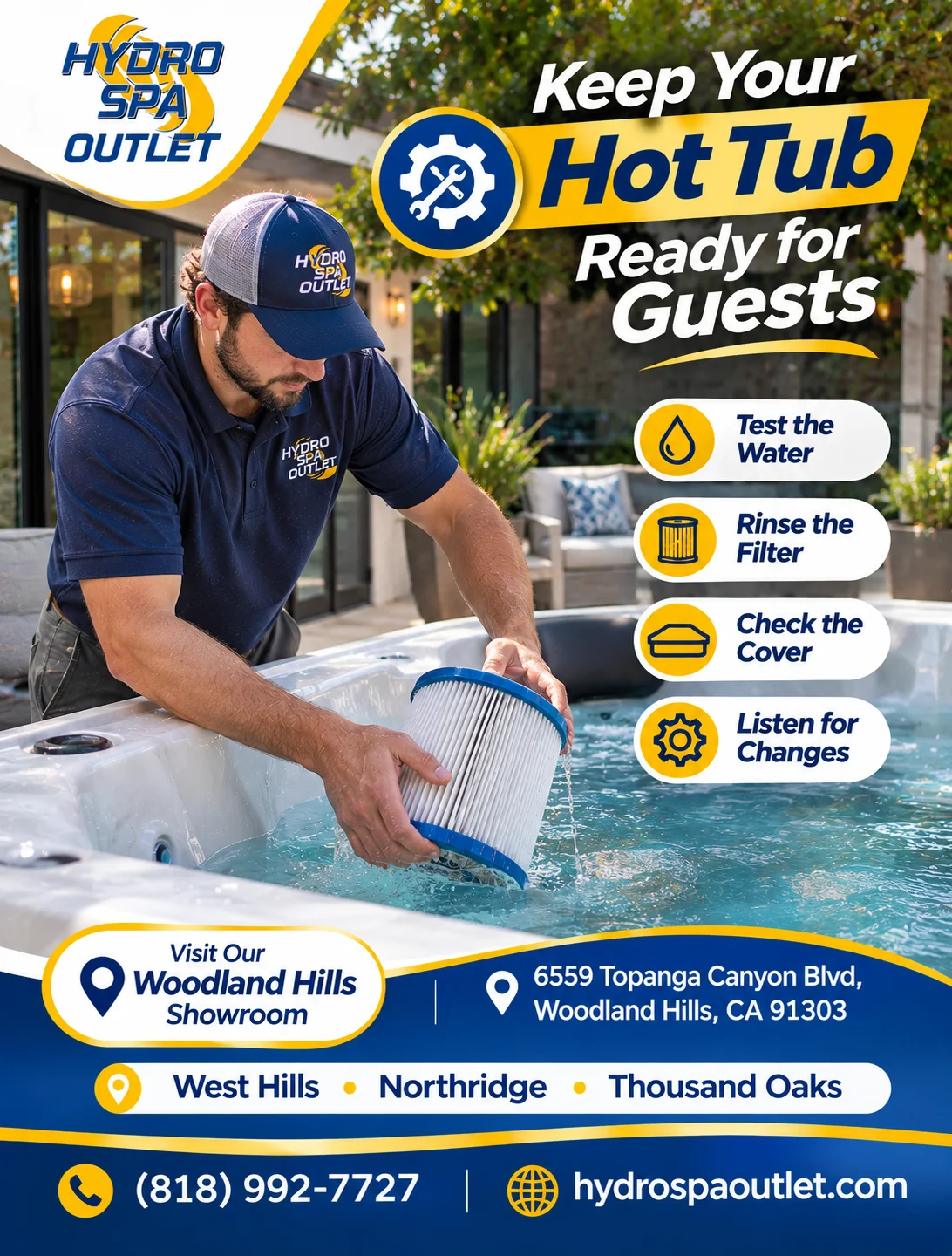
A few habits that help:
- Rinse filters regularly and deep-clean them on a schedule. After windy weather, check them sooner.
- Test and balance water chemistry often. Water that’s out of balance can encourage scale or corrosion.
- Drain and refill on a regular cycle so dissolved minerals don’t keep concentrating.
- Keep the cover on and in good shape. It holds heat in and keeps debris out.
After a repair, water care is especially important, since a fresh heater or sensor should start life in clean, balanced water. Our guide to water care after a spa repair covers that period in detail.
If you’d rather not handle the routine yourself, Hydro-Spa Outlet offers hot tub maintenance as well as drain and cleaning service. Regular visits are a practical way to spot a weak pump or a scaling heater before the panel lights up. Get in touch and we’ll set up a schedule that fits how you use your spa.
Frequently Asked Questions
What does the FL code mean on a Jacuzzi hot tub?
On many Jacuzzi models, FL or a similar flow code means the controller isn’t detecting enough water moving through the heater. A dirty filter, low water, or a closed valve is the usual cause, though a failing pump or flow switch can also trigger it.
Is it safe to keep resetting my hot tub when it shows an error?
One power cycle to clear a glitch is reasonable. If the code comes back, or if your breaker or GFCI keeps tripping, stop resetting it and call a technician, since repeated restarts can mask a real fault and stress components.
Why does my spa show more errors in Los Angeles than the manual suggests?
Local conditions play a role. Hard water leads to scale on heaters and sensors, Santa Ana winds blow debris into filters, and summer heat can push water temperature up, all of which can trigger flow or overheat codes.
Can a dirty filter really cause a heater error?
Yes. A clogged filter restricts flow, and the heater depends on steady flow to run safely. When flow drops, the controller often shuts the heater off and posts a flow or overheat code.
Do you repair hot tubs that you didn’t sell or install?
Hydro-Spa Outlet provides hot tub repair and maintenance for spas in the Los Angeles area. Contact us with your spa’s make, model, and the code you’re seeing, and we’ll let you know how we can help.
The short version
Error codes are your spa protecting itself. Start with the safe checks: filter, water level, valves, one power cycle. If the code sticks around, or anything involves the breaker, wiring, or heater, let a professional handle it. When your Jacuzzi starts talking in letters, Hydro-Spa Outlet is here in Los Angeles to translate. Reach out and we’ll help get your water warm again.