Most hot tubs are protected by a GFCI breaker, a device built to cut power when it senses a tiny current leak to ground. When yours keeps tripping, that’s the breaker doing its job. Here in Los Angeles, older backyard wiring, coastal moisture and hard water all feed the problem. Let’s walk through why it happens.
What does it actually mean when a hot tub trips the breaker?
It means the breaker saw something it didn’t like and shut the power off. Spa circuits typically use a GFCI (ground fault circuit interrupter), which compares the current going out on the hot leg with the current coming back. If a small amount goes missing, usually because it’s leaking to ground through water or a damaged part, the GFCI trips almost instantly. A standard overload trip is different. That happens when the tub draws more current than the circuit is rated for, often when the heater and pumps run at the same time. Both are safety shutoffs. Neither is a glitch to ignore. A spa combines water, people and high-voltage equipment, so a breaker that trips is telling you something real about the system. The useful question isn’t how to stop the trips. It’s what’s causing them.
Which parts usually cause the trip?
The heater is the most frequent culprit. Heating elements sit in water, and when the sheath corrodes or cracks, current can leak to ground and trip the GFCI. Pumps are next. A failing seal can let water creep into the motor, and worn motor windings can short. Other common suspects include:
- Moisture or condensation inside the control box or equipment bay
- Corroded or loose wire connections at the control board or terminal block
- A damaged ozonator or circulation pump
- Chafed wiring where it passes through the cabinet
- A worn-out GFCI breaker that’s become oversensitive
Breaker trips often show up alongside other system alerts, so it helps to know the codes your control panel displays. Our guide to diagnosing common Jacuzzi error codes explains what those messages usually point to.
Why does it trip only when the heater turns on?
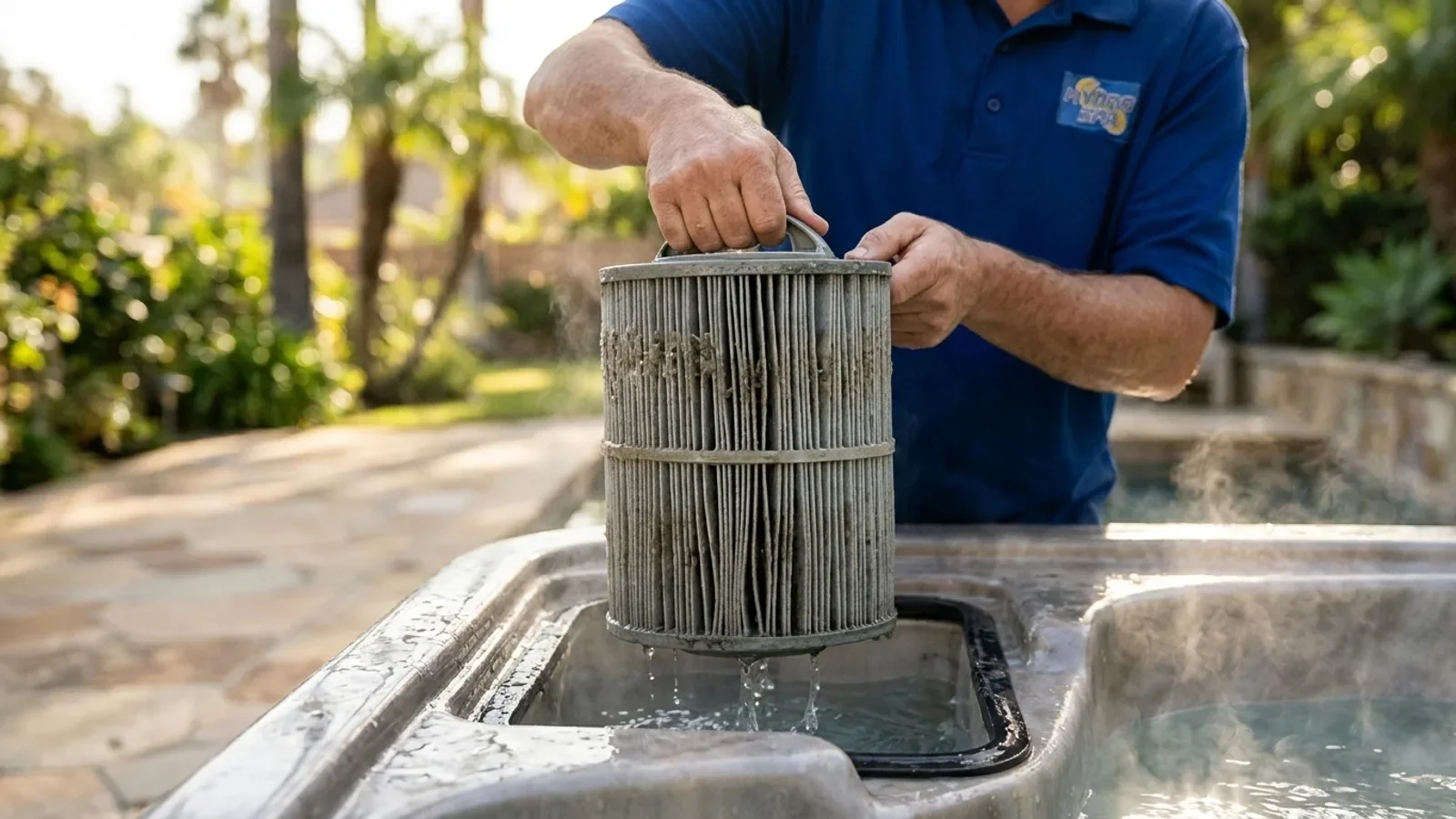
This pattern is one of the clearest clues you’ll get. If the spa runs fine on jets alone but trips the moment the heater kicks in, the heating element is a prime suspect. As elements age, mineral scale builds up on the surface, the element runs hotter, and the metal sheath can eventually corrode or split. Once that happens, water touches energized metal and a ground fault follows. It can also be an overload issue if the circuit is undersized for the heater and pumps running together. Scale is a big factor in this area, and we cover it in detail in our article on how hard-water scale damages spa heaters. A technician can test the element’s resistance and its insulation to ground to confirm. That’s work for a pro with the right meter. It isn’t a homeowner check.
Why are Los Angeles hot tubs especially prone to breaker trips?
A few local conditions stack up here. Southern California water is hard, often noticeably so, and mineral scale is hard on heaters. Near the coast, from Santa Monica down through the South Bay, salty marine air speeds up corrosion on terminals, relays and exposed metal in the equipment bay. Then there’s the wiring itself. Much of LA’s housing stock dates from the mid-twentieth century, and many spas were added later to circuits that weren’t planned for them. Some older setups lack modern GFCI protection or run on undersized wire. Our dry autumns and rare but heavy winter storms add another twist. When the first real rain arrives, water can find its way into equipment bays that sat bone-dry for months. A spa that behaved all summer may start tripping after a storm. Electrical requirements for spas vary by jurisdiction, so check with your local building department or a licensed electrician about your specific setup.
Is it safe to just reset the breaker?
One reset is reasonable. Repeated resets are not. If the breaker trips once after a storm or a power blip, flipping it back on and watching what happens is a sensible first step. If it trips again, stop. Each trip is the GFCI catching current going where it shouldn’t, and resetting over and over is just asking a safety device to look the other way. Never bypass a GFCI or swap in a larger breaker to make the problem go away. Those moves remove the protection that keeps people safe in the water. Keep everyone out of the tub while the issue is unresolved. Then call a professional. Spa electrical work involves high voltage near water, and diagnosis belongs with a qualified technician or licensed electrician.
What can I safely check before calling for repair?
There are a few low-risk observations that help a technician narrow things down fast. None of them involve opening electrical panels or touching wiring.
- Note the timing. Does it trip instantly on reset, when the heater starts, when jets come on, or at random?
- Check for recent rain or hosing. Did water get near the equipment bay or the outdoor disconnect?
- Look for visible leaks. Water pooling under the cabinet can point to a pump seal or fitting.
- Write down any error codes on the topside panel before the power cuts out.
- Check the cover. A waterlogged or damaged cover can let moisture collect where it shouldn’t.
That’s it. Leave the panels closed. If you want a structured list of what to note before your service visit, our checklist of questions to answer before a spa diagnostic is a good companion.
Could the problem be the breaker and not the hot tub?
Sometimes, yes. GFCI breakers wear out, and an aging unit can become oversensitive and trip on normal operation. Corrosion inside an outdoor disconnect box, common in our coastal neighborhoods, can also cause nuisance trips. Loose connections at the panel are another possibility. The tricky part is telling a tired breaker apart from a real ground fault inside the spa, because the symptoms look identical from the outside. A technician isolates components one at a time, testing the heater, pumps and other loads, to see whether any of them are leaking current. If everything inside the tub tests clean, attention shifts to the breaker and supply wiring, which is a job for a licensed electrician. Swapping the breaker first without testing the spa can hide a genuine fault. Test first. Replace second.
How does breaker tripping relate to other spa errors?
Electrical faults rarely travel alone. A heater that’s scaling up may also trigger overheat or high-limit codes. A pump with a failing seal might cause low-flow alerts before it ever trips the breaker. Flow problems are worth special attention, since restricted circulation makes the heater work harder and can speed up element damage. If your panel has been flashing a flow warning, read our breakdown of what causes the FL flow error too. Seeing the full pattern helps. A trip plus a recent flow code points in a different direction than a trip with a clean history. When we diagnose a spa, we look at both, and our Los Angeles hot tub troubleshooting resource pulls the common alerts together in one place.

What does a professional repair usually involve?
A proper visit starts with diagnosis, not guesswork. The technician will typically confirm the trip pattern, then test individual components for leakage to ground, check connections in the control box for corrosion or heat damage, and inspect pumps and seals for water intrusion. Depending on what’s found, the fix might be a new heating element, a pump seal or motor, cleaned and re-secured connections, or drying out and protecting a damp equipment bay. Cost depends on which part failed, how accessible it is, and whether related damage has spread. If supply wiring or the breaker itself is the issue, that falls to a licensed electrician. Once the tub is running again, water chemistry matters for keeping the new parts healthy, and our notes on caring for your water after a repair cover that. When you’re ready, you can book a hot tub repair visit with our team.
The short version
A tripping breaker is a safety system catching a real fault, most often a corroded heater, a leaking pump, or moisture in the electronics. In Los Angeles, hard water, coastal air and older backyard wiring make those faults more common. Reset once, observe, keep people out of the water, and skip the risky DIY. If the trips keep coming, Hydro-Spa Outlet can track down the cause and get your spa back to dependable soaks.